Monday, 21 March 2016

Ethnic Cleansing in Europe, 2016


A very poignant moment.

My son is simply mad about soccer. He knows every statistic, every name, and he loves every team (except Chelsea).

And so I passed by this expo at Place St Gery in Brussels - which I visited for the first time earlier this week - with him. It is about Ukrainians who have been displaced following the Russian invasion and illegal annexation of Crimea.

Some 10,000 Crimean Tatars have been made to leave their homeland, and many others are forced to take Russian citizenship against their will. Those who were outside the region at the time of annexation are forbidden to return home to their families.


Their mosques are being closed, politicians are persecuted, and the only Tatar language TV station has been closed down on the orders of the Kremlin.

This is ethnic cleansing - not yet on the scale of what the Nazis did, but it is still early days, and the signs are pointing in that direction.

The gentleman featured in this picture, Roman Podenezhny, is a teacher, and like George, is clearly a football fan.

George would even be able to speak with him in his own tongue (George has better language skills than I do, but you might say that about anybody).

We had talked about the invasion, about war, and what it means to the people who have been caught up in it.

George looked at the picture of this chap and said "He's just like me."

That is the whole point. The dispossessed, the refugees, the dead and the wounded victims of war are just like us. The victims of war are us.

A Glimpse Into The Past......

This is an archaeological dig in the centre of Brussels.

We don't know exactly what this is, it was  recently discovered whilst the ground was being prepared for some hideous development which, whatever it is, will certainly offend my eyes.

I spoke at the site today with an expert on medieval masonry who is certain that what we are looking at is a 15th or 16th century brewery. The location is perfect - very close to the river (now the canal) that runs through the city. Also, there were a number of monasteries in the area, and as we all know, monks liked a tipple. It is exactly where the brewing industry on what was then the outskirts of Brussels developed into what it is today.

The brickwork is superbly preserved. It looks as if these bricks were laid yesterday.

George and I were delighted to see what was clearly a toilet, made out of stone, complete with even a drainage pipe. This predates the inginuity of Thomas Crapper by some 400 years.

Sadly, there may only be another week to explore the site, although representations are being made to the City council to grant an extension until May.

But either way, soon this view of the past will be lost forever.

Thursday, 17 March 2016

More hypocrisy from Farage

STAY OUT OF IT: Ukip leader Farage warns Obama NOT to wade into EU debate - so the Daily Express reports today (Mar 17).
This is yet another example of Farage's hypocrisy.
Where will Farage be on April 4th?
He will be in Amsterdam, sharing a platform with far-right (and allegedly Kremlin backed) minor politicians, telling the Dutch that they should vote against ratification of the Free Trade Agreement with Ukraine.
Does this man have no shame?
Or is he merely so self-obsessed that he say anything to get himself into the newspapers?
Or is there something more to this than meets the eye?
The chap in the photo alongside Farage is a certain Alexander Yakovenko, former Deputy Minister of Foreign Affairs of Russia. The two had appeared together on Russian TV.
Farage has regularly appeared on RT, the Kremlin funded Russian propaganda channel, and questions have been asked about his relationships with Russia's media. 

http://www.theguardian.com/politics/2014/mar/31/nigel-farage-relationship-russian-media-scrutiny

https://euobserver.com/political/129071


Tuesday, 15 March 2016

As others see us


There is an air of panic amongst many of the British staff members and assistants in the EU institutions at the moment, as they prepare themselves for what the press here have dubbed "Brexodus".

There is also a certain amount of hostility from staffers from other EU member states who realise that without UK money, there own lucrative 'jobs for life' may not be as secure as they had assumed.

One Hungarian friend recently (he was well into the 3rd hour of his lunchbreak, and was somewhat the worse for it) told me that they want us to go. They are fed up with us Brits spoiling everything.

The French are also less than happy with us. How many times we are expected to go to Europe to get the French out of trouble I don't know?

It's vital that we have this debate, and that it is settled once and for all by public referendum. I strongly suspect that the vote will be to leave the EU.

The Eurozone crisis, the migrant crisis, and the rise of populism almost certainly herald the end of the EU as we currently know it. It has proven itself to be fractured, inconsistent, lost, and downright inept in the face of challenge.

If one example throws light onto the level of incompetence in the EU, it is the formation of the External Action Service.

When work on the new lavish headquarters began, and staff were being recruited, it emerged that there was no budget line to cover it. It simply never occurred to them that it had to be paid for.


Sunday, 6 March 2016

Boris Mikhailov in Antwerp


Boris Mikhailov, from Kharkiv in Ukraine, is regarded as the most important fine art photographer to have emerged from the Soviet era.

He began exhibiting in the 1960, and quickly fell foul of the KGB, losing his job as an engineer when it was found that he had taken nude photographs of his wife.

Subsequent series of his works are considered as criticisms of the Soviet system through the sheer
frankness with which he shows life as it really was.

He is currently being exhibited at FOMU, the photographic museum in Antwerp.

His early work in the 60s involved layering colour transparencies, and many of these are shown by means of a slide show, lasting several minutes, to the soundtrack of Pink Floyd. 

When these images were first shown, it had to be done secretly in private homes.

But to see how far Eastern Europe has come since the collapse of the evil empire, it is his Red Series and Salt Lake that show life as it really was. It is hard now for us to imagine that Europeans really lived like that, although in many parts of Russia, and possibly Moldova, little, if anything, has changed. 

The Red series portrays the social system that emerged out of the October Revolution, whilst the somewhat grim Case History shows the homeless and dispossessed who were left behind after the fall of the Soviet Union.

I found the latter to be somewhat 'staged', and so for me as an attempt at social documentary it didn't really work. 


We were very lucky to attend a Vernissage in advance of the official opening. Mikhailov himself was present at what was a superb event. 

The Ukrainian community in Antwerp is very lively, and the turn out at such cultural events is always high.

The exhibition far exceeded my expectations, and is well worth visiting.


The exhibition runs until June 5th, details can be found here:
http://www.fotomuseum.be/en.html

Saturday, 5 March 2016

Randall Calvin


My very good friend Randall Calvin passed away just some days ago.

We arrived in Brussels around the same time - he just some months after me - and we quickly became good mates. He  worked with the Socialists teaching languages, I worked with the Eurosceptics.

Later he was to concentrate on citizen journalism, an activity which he based on social media, and which he was very good at.

From his apartment he once filmed the brutal beating of a young Arabic guy by a group of Brussels police officers. I won't go into details, but it was horrific. The resulting video went viral, and is now used as a training aid by Belgian police to illustrate how quickly things can go wrong.

He once interviewed me in the middle of a riot outside the European Parliament. To a backdrop of riot police, teargas, and sirens, I stood alongside a pyre of burning tractor tyres speculating about the future of European democracy. It was great fun!

But my favourite memory (although I probably shouldn't admit this) was inside the parliament, just before Christmas 2012.

An elderly priest from Rome was leading a group of Italian MEPs in prayer, when Randall made what I can best describe as an 'intervention'. He was a committed atheist, and was never shy about sharing his views in public. The resulting chaos is talked about fondly to this day.

As a result of another interesting discussion on religion, with a Sikh, he was to become, in his 30s, the first man I know to be banned from his local sweet shop. As a result he had to lurk on the corner, like a guilty schoolboy, asking people to go in and buy him cigarettes, which I found hilarious.

The last time I saw Randall, about 3 weeks ago, he was enthusiastic about a new role he had found, visiting an elderly British WW2 veteran who is now in a Brussels nursing home. I know the chap in question, Eric, as he was for many years the standard bearer for the local branch of the Royal British Legion.

Actually, our conversation took place on the exact spot where the picture of us at the beginning of this post was taken on November 11th 2013. The chap in photo on the wall behind us is our dear friend Glynne Davis, another WW2 veteran, who passed away a few years ago at the grand age of 99.

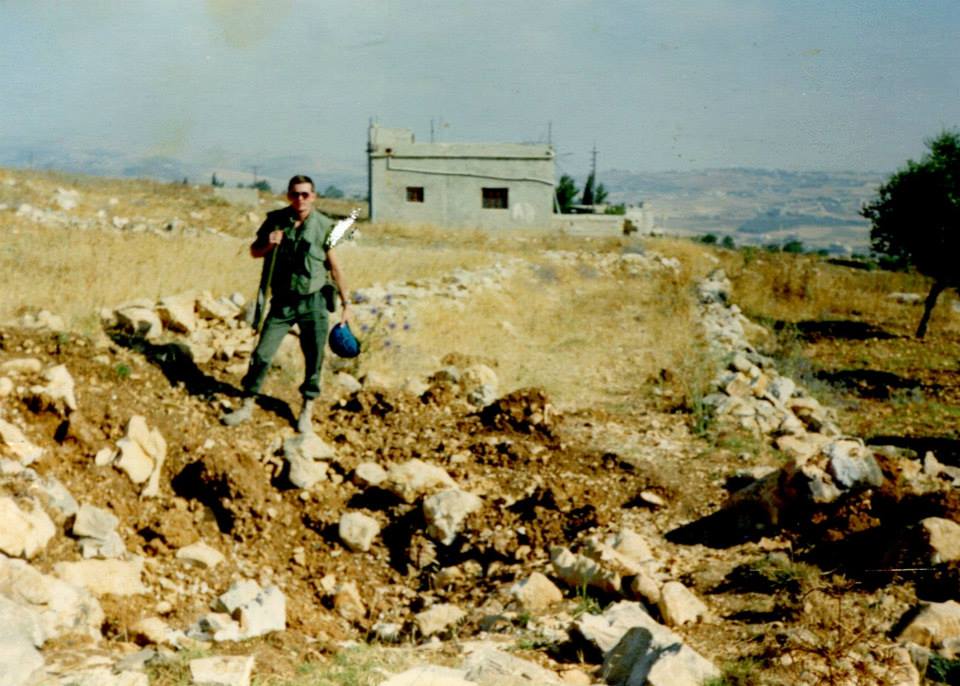
On the right is Randall in the Lebanon in 1989.

Randall could be a difficult person sometimes, and could become very emotional very quickly. But he was very much a part of my life for most of my time in Brussels so far.

I spent many hours with him, and his lovely wife Raquel, over the years.

Randall's funeral will be held at St. Patrick's Garrison, Galway, today. He will be missed.

Rest in Peace.

Thursday, 11 February 2016

Belgian Art 1868-1914

It is one of Brussels' newest museums - if not the newest - but what a great joy it proved to be!

Fin de Siecle (end of century) covers Belgian art from 1868-1914. I thought I knew at least something about this period having lived in the city for a long time, but this really opened my eyes.

My enchanting companion, Inna, who knows rather a lot about art, was also impressed.


I thought it was going to be a two hour visit, but after three hours the staff were literally pushing us towards the exits - there was so much more to see, and to talk about.


Its close to the EU institutions - should any of the Philistines wish to visit, which I doubt - but also just some minutes walk from Grand Place and the major tourist attractions.

I strongly recommend this.

www.fin-de-siecle-museum.be

Wednesday, 10 February 2016

A Memorial To Belgian Occupation Forces

A slightly unusual memorial - to those Belgian soldiers who died whilst serving abroad in the aftermath of the two World Wars, and during the Cold War.

It is very close to Square Marie-Louise, one of my favourite corners of Brussels.

The Square also boasts the memorial to Lt. General Louis Bernheim, the Jewish soldier who fought through the Great War and who died in 1931.


I had a slight mishap myself just here, back in the Summer of 2014. Just to the right of the white van is the spot where I was hit by a car while crossing the road.

Having had my legs swept out from under me, I took most of the force in my face before bouncing off the bonnet, over the car, and landing in the road on my head. There was rather a lot of blood, and nobody was as surprised as me that I was able to get up and walk away with just a broken nose.

I've actually broken my nose so often - 5 times at the last count - that I am getting rather bored with the experience.

The first time was the worst, I copped a roller skate in the face whilst in the Scouts. For about 6 years my nose pointed a bit to the left, but a right hook from a Geordie at RAF Wattisham straightened it out somewhat.

I started to get used to it after that.


Sunday, 31 January 2016

August Sander: People of the 20th Century


I saw today, in Antwerp, August Sander's great portraits 'People of the 20th Century'.

From his early life before the First World War until his death in the 1960s, Sander recorded on film what ordinary German people looked like.

During the Nazi era his work had to be hidden, as it showed people who were not supposed to exist. A lot of his work was destroyed at that time. Fortunately for us, much of it was saved not just from the Nazis, but from the Allied bombings of Cologne which devastated the city.

The expo runs until Feb 14th. Details here:  www.fomu.be I strongly recommend it.


Sunday, 24 January 2016

Her Time Has Come......

This astonishing Elm tree, reputed to be more than 250 years old, stands just 5 minutes from my front door. It is rare now for Elms to live so long, because of the combined effects of disease and pollution.

This beauty stands in the gardens of Paradis des Enfants, a local school. There was a nice shelter underneath the tree, where I liked to sit and read a book while my son played football on the practice pitches. It's a lovely little corner of Woluwe St Pierre.

The shelter has been taken away, and the tree is now fenced off. The roots are solidified and rotting, and so she has to come down.

So today I took some pictures of this incredible tree. The bark, which looks so gnarled and magnificent, comes away at the touch. Her time has come. But to the end she is beautiful.

You have to get up very close to appreciate this, so I did, and I hope that you enjoy the pictures. The colour and texture speak of centuries of growth.

When this tree first began to grow, the nation of Belgium did not even exist.

Through independence and two world wars it survived. The district in which it stands is where British troops, under the command of Field Marshall Montgomery, who's memorial stands guard over the approach to Brussels to this day, and just 5 minutes walk away, first arrived in September 1944, and were bogged down by the Germans in Auderghem, literally on the other side of the road from Paradis des Enfants.


The great Belgian painter and sculptor Constantin Meunier, who passed away in 1905, and who lived little more than a stone's throw away, had not even been born when this tree was in full growth.

It is about 10 minutes walk away from the studio where Herge created Tin-Tin.


Saturday, 9 January 2016

When the wheels fall off a good story....

Nigel Farage is probably regretting the 'assassination' story a bit right now.

I realised there was something iffy  about this when he said he did not want the police to investigate because he didn't want people to know where he parks his car when he is in Brussels. Errr... how about the MEPs car park underneath the parliament?

Its very secure, and just some moments walk away from Rue Montoyer.

But this has happened before, of course.


In 2011 British police were investigating former MEP Chris Huhne over a traffic offence. The investigation hinged largely on whether Huhne had been on a certain flight from Strasbourg to Stanstead on March 12th 2003, or if he had travelled the next day.

Never one to miss a media opportunity, Farage announced that he remembered being on that flight with Huhne. Then it went a bit wrong.

Essex police called to take a statement. Farage was forced to admit that he didn't really remember at all.

When Malaysian Airlines Flight MH-17 was shot down over Ukraine on July 17th 2014 with the loss of 298 lives, Farage made a statement. Apparently he was at Schipol airport at the same time that the passengers were embarking on the doomed jet.

This is attention seeking at it's most crass. But I'm sure will hear more of it in the future.


Sunday, 3 January 2016

Pop Art in Belgium


A great afternoon at the 'Pop Art in Belgium' expo.

Inna is in front of Discs, a painted composition in which James Rosenquist assembled the front of a car, gramophone discs and a box of Kleenex tissues.

Before entering the art world, Rosenquist earned his living as a billboard painter. The style which he developed in this capacity remained visible in his work and is illustrative of the way in which American Pop artists introduced other painting techniques into the art world.


C'est Moi, with ten works by one of the masters of Pop Art, Roy Lichtenstein.

Ben-Day dots, thick black contours. Large
areas filled with primary colours and simplified compositions are elements that were also embraced in the consumption and comics culture. The landscape was one of the first subjects which Lichtenstein explored after he had broken through with his appropriation of the comics style.

This series contains all the stylistic elements that characterise his work.

It's a great expo, most of the works are from the ING bank collection, some are from private collections.


The expo runs until Feb 14th.

Details at https://about.ing.be/About-ING/Art/PopArt.htm